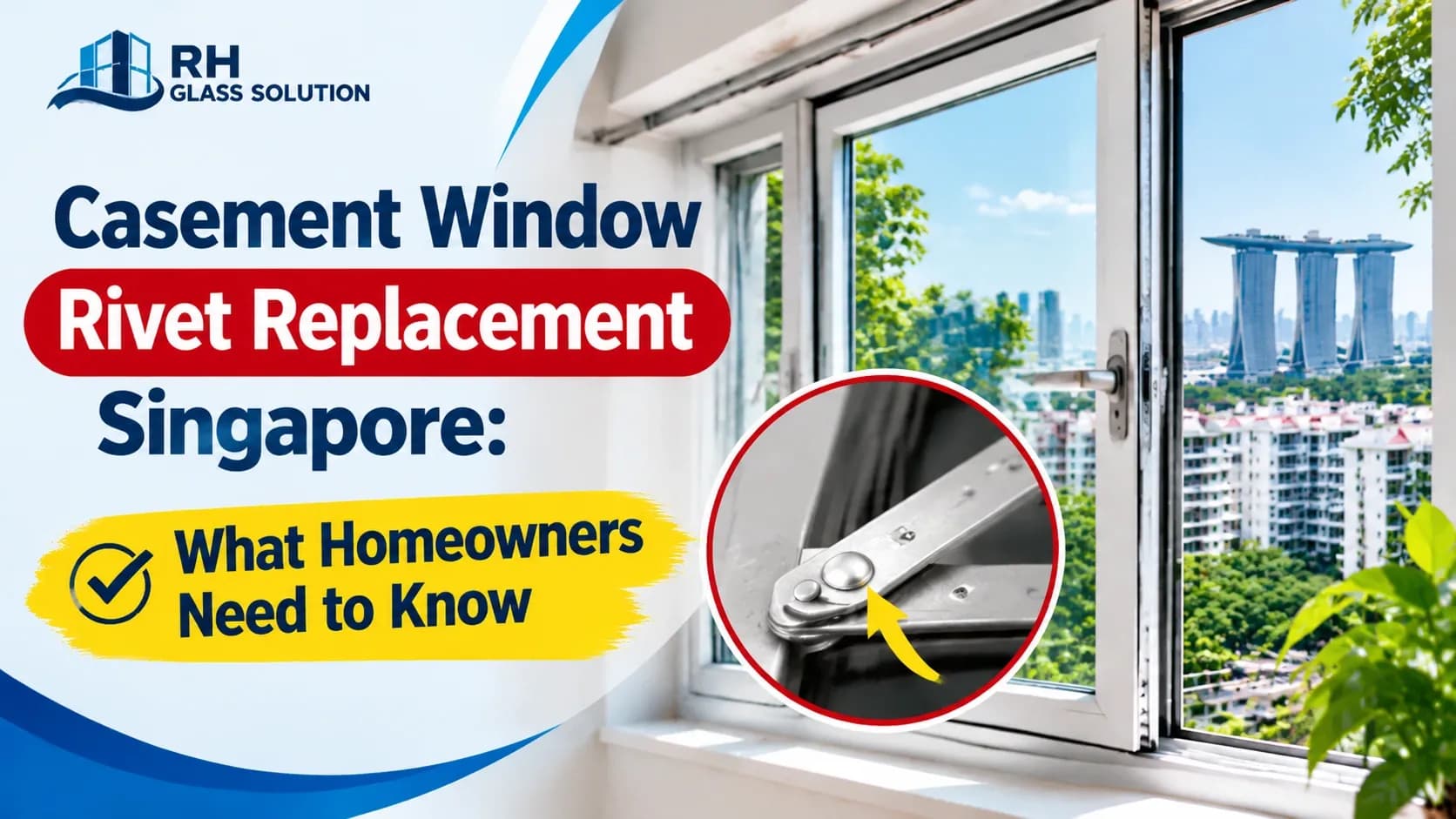
Casement Window Rivet Replacement Singapore: What Homeowners Need to Know
If your casement window has aluminium, rusty, loose or missing rivets, arrange an inspection by an appropriately approved window contractor. In Singapore, aluminium rivets at the friction stays of casement windows must be replaced with Type 304 stainless-steel rivets or an equivalent compliant grade. These fasteners help secure the window panel to its supporting friction stay.
Do not replace rivets yourself or keep operating a window that appears loose, sagging or unstable. Keep people away from the area below the window if there is a risk of a part becoming detached, and contact a qualified contractor. BCA advises homeowners to check and maintain windows at least once every six months.
Why casement window rivets matter
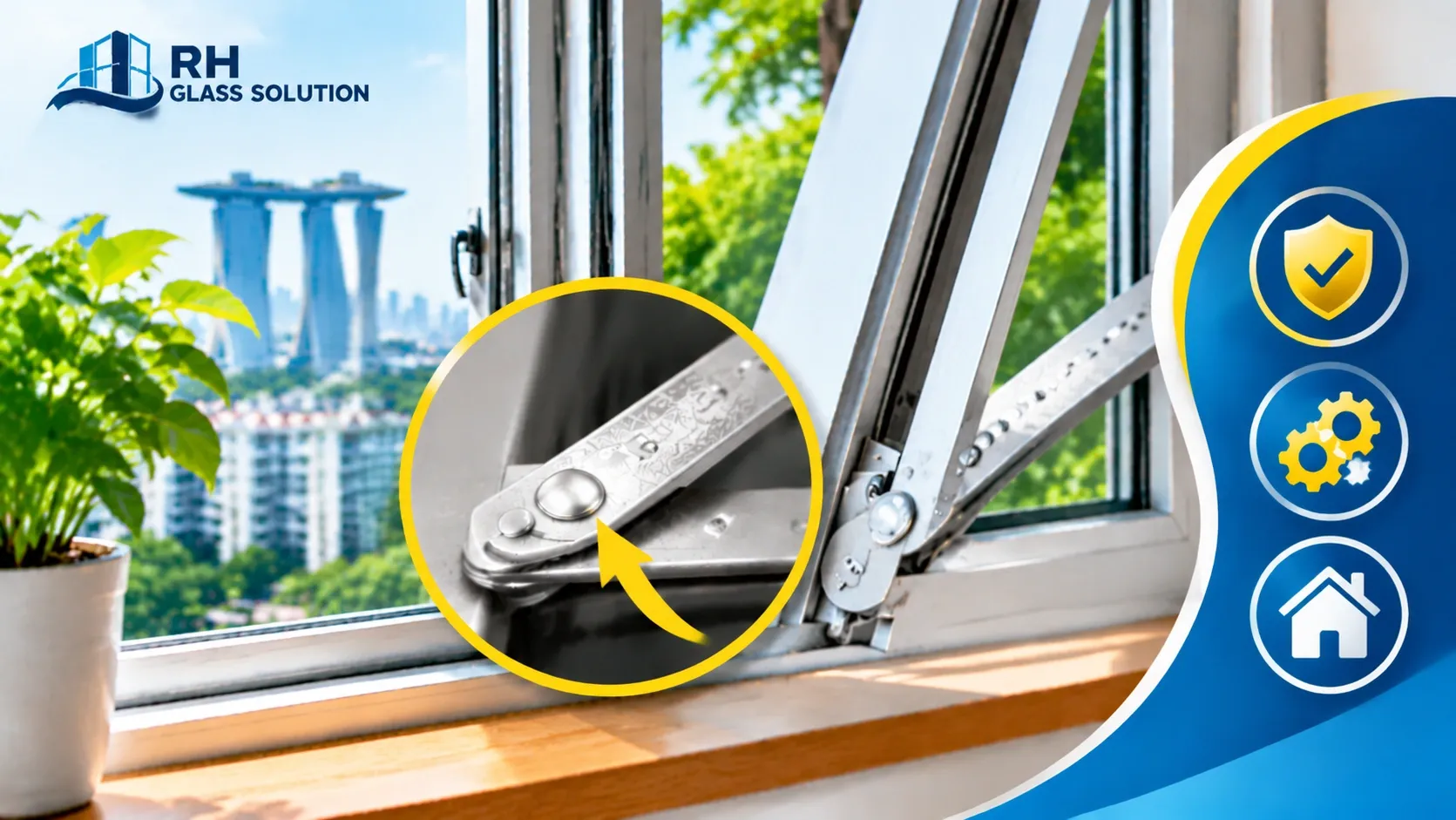
A casement window is a panel that opens on hinges or friction stays. A friction stay is the metal arm mechanism that supports and controls the panel as it opens and closes. Rivets or other specified fasteners connect parts of this mechanism to the window assembly.
If a rivet corrodes, breaks, loosens or goes missing, the connection may weaken. The panel can become difficult to control, sag, move unevenly or become unsafe. A window that still opens does not necessarily have secure fixings. Singapore's rain, humidity and repeated window movement can contribute to deterioration, but the exact cause should be confirmed on site.
What Singapore's BCA requirements say
BCA's window-safety guidance says homeowners should replace all aluminium rivets at the variable-geometry stays of casement windows with Type 304 stainless-steel rivets complying with BS EN 10088 or an equivalent standard. Retrofitting must be carried out by an approved window contractor and trained window installer.
For HDB flats, the contractor must be BCA-approved and listed with HDB. HDB also sets out permit and reporting steps for relevant window works. Ask the contractor to confirm the requirements that apply to your flat and the specific work before the appointment.
HDB's casement-window maintenance guide gives additional technical details for common rivet and friction-stay problems. For the specified repair scenario, it identifies Grade 304 stainless-steel rivets with a minimum diameter of 4.8 mm and sets out fixing quantities on each side of the friction stay. The correct arrangement depends on whether the window is an existing casement window or a newly retrofitted or replaced one. The contractor should follow current official technical guidance.
These requirements concern the safety and compliance of the window assembly. They are different from ordinary glass replacement, sealant work or a cosmetic adjustment.
Signs your casement window may need attention
Visible aluminium-coloured rivets at the friction stay, especially if the window has not been retrofitted.
Rivets that look rusty, corroded, cracked, loose or partly detached.
A window panel that sags, tilts or sits unevenly when opened.
A friction stay that looks bent, loose or distorted.
A window that suddenly feels heavier, moves irregularly or no longer stays in position.
Unusual movement or a change in the gap between the window panel and frame.
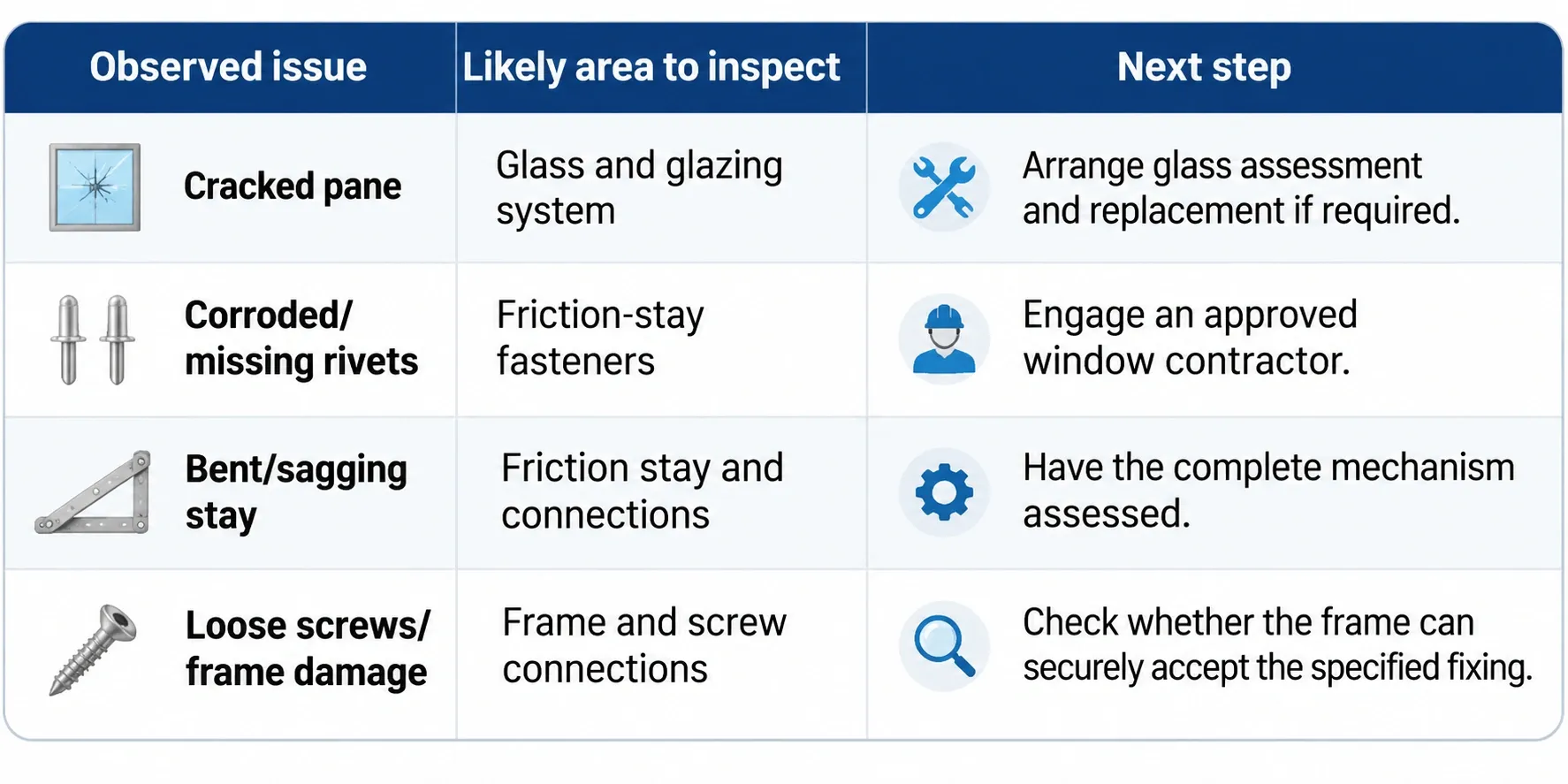
These signs do not prove that the rivets alone are at fault. A worn friction stay, loose screws, damaged frame section or deteriorated corner bracket may also need attention. Avoid forcing the panel to test it.
Rivet replacement is not the same as replacing the glass
The glass pane, aluminium frame, friction stay and rivets perform different jobs. A cracked pane may require glass replacement. A corroded rivet or damaged friction stay is a hardware and window-safety issue. Replacing the glass will not correct a weak friction-stay connection.
A proper inspection should identify the failed component and check the surrounding fixing points. If the friction stay itself is bent, loose or damaged, replacing only one rivet may leave the underlying problem unresolved.
How casement window rivet replacement is carried out
The exact work depends on the window type, access, condition and applicable requirements. A qualified contractor should inspect the complete assembly and explain the proposed scope.
Initial enquiry and safety check. Describe the window type, symptoms and property type. Share photos only if safe; never lean outside the window.
On-site inspection. The contractor checks rivets, friction stays, screws, frame connections, alignment and related hardware.
Scope confirmation. The contractor explains whether rivet replacement alone is suitable or whether a damaged friction stay also needs replacement.
Approved retrofitting. The approved contractor and trained installer use the specified stainless-steel fasteners and fixing arrangement.
Final checks and handover. The contractor checks that the panel is properly secured and provides the applicable completion or retrofitting report.
Who should you engage in Singapore?
For casement-window rivet retrofitting, verify the contractor's approval for window works. BCA identifies an approved window contractor as a firm registered under the relevant window-contractor workhead, and the work must involve a trained window installer. For an HDB flat, also confirm that the contractor is listed in HDB's directory.
Before confirming an appointment, ask:
Are you currently a BCA-approved window contractor for this work?
For an HDB flat, are you listed in HDB's directory?
Will a trained window installer carry out or supervise the work?
Will you inspect all casement windows and relevant fixing points?
Which rivet material, grade and size will be used?
Will I receive the required completion report?
Does the quote include inspection, hardware, labour, access and follow-up?
Check the contractor against the official BCA and HDB directories rather than relying only on an advertisement or verbal assurance.
How much does casement window rivet replacement cost?
There is no single reliable price for every Singapore home. Cost depends on the number of windows, number and condition of friction stays, whether the stays also need replacement, access conditions and any additional repairs.
Ask for an itemised quotation covering inspection, rivets and other hardware, friction-stay replacement if needed, labour, access costs and documentation. Compare quotations on the same scope. Do not use general glass-replacement prices as a proxy for rivet-retrofitting costs; they are different jobs.
HDB flats, condominiums and landed homes
HDB flats
HDB owners should engage a BCA-approved window contractor listed with HDB for relevant window repair, retrofitting or replacement. Confirm the applicable permit and reporting steps and keep the completion documents.
Condominiums and private apartments
Verify that the contractor is approved for the required window work and that a trained window installer is involved. Check with the managing agent or MCST about access, work hours and building-specific requirements. Glass-replacement experience alone does not prove approval for casement-window rivet retrofitting.
Landed properties
Requirements can differ by property type and work scope. Ask the contractor to confirm whether the specific window and building fall within the relevant retrofitting requirements before work begins.
A six-month window maintenance check
BCA and HDB recommend regular checks. Inspect windows at least every six months, following the Check, Clean and Change approach.
Check that fasteners are not rusty, loose, broken or missing, and that friction stays are not bent or loose.
Clean accessible moving parts carefully and lubricate joints where the manufacturer's guidance allows.
Change aluminium rivets to compliant stainless-steel rivets through an approved window contractor. Replace worn or damaged components as advised.
Never lean outside the window, climb onto a ledge or dismantle a friction stay to inspect it. If a window looks unstable, stop using it and arrange professional help.
Common mistakes to avoid :
Replacing only the visibly damaged rivet without checking other fixing points and the friction stay.
Assuming stainless-looking hardware is automatically the correct grade.
Hiring a general handyman without checking approval and trained-installer status.
Continuing to open a loose or sagging window while waiting for repair.
Failing to obtain and keep the relevant completion report.
Confusing glass replacement with hardware retrofitting.
Frequently asked questions
Do all casement windows in Singapore need stainless-steel rivets?
Ans: BCA's retrofitting requirement applies to aluminium rivets at the variable-geometry stays of casement windows in covered residential buildings. A contractor should inspect the window and confirm the work required.
Can I replace casement window rivets myself?
Ans : No. Retrofitting must be carried out by an approved window contractor with a trained window installer. Do not dismantle a potentially unstable window yourself.
What type of rivets are required?
Ans : BCA specifies Type 304 stainless-steel rivets complying with BS EN 10088 or an equivalent standard. HDB's technical guide gives additional details for particular repair situations.
How often should I check my windows?
Ans : BCA and HDB advise homeowners to check and maintain windows at least once every six months.
Does a rusty rivet mean I need a new window?
Ans : Not necessarily. The contractor should assess the rivets, friction stays, frame and surrounding connections. Some cases need fastener replacement; others may also require a new friction stay.
Is rivet replacement the same as glass replacement?
Ans : No. Rivet replacement addresses hardware connections. Glass replacement addresses a damaged or unsuitable glass pane.
Do HDB owners need an approved contractor?
Ans : Yes. Engage a BCA-approved window contractor listed with HDB for relevant work, and confirm permit and reporting requirements.
What should I keep after the work?
Ans : Keep the quotation, work scope, contractor details and applicable completion or retrofitting report.
Need help with glass window installation or replacement?
If your concern is a damaged glass pane, a new glass-window installation or an upgrade to an existing window system, review RH Glass Solution's glass window services and discuss the window type, measurements and intended use with the team.
Written by
Rh Glass Solution
Part of the RH GLASS SOLUTION PTE LTD team: 24/7 glass replacement, installation and repair across Singapore.
You might also like
All articles
Spontaneous Tempered Glass Breakage on Balconies in Singapore: Causes, Safety and Prevention
Is Stainless Steel Railing Rust Proof in Singapore?