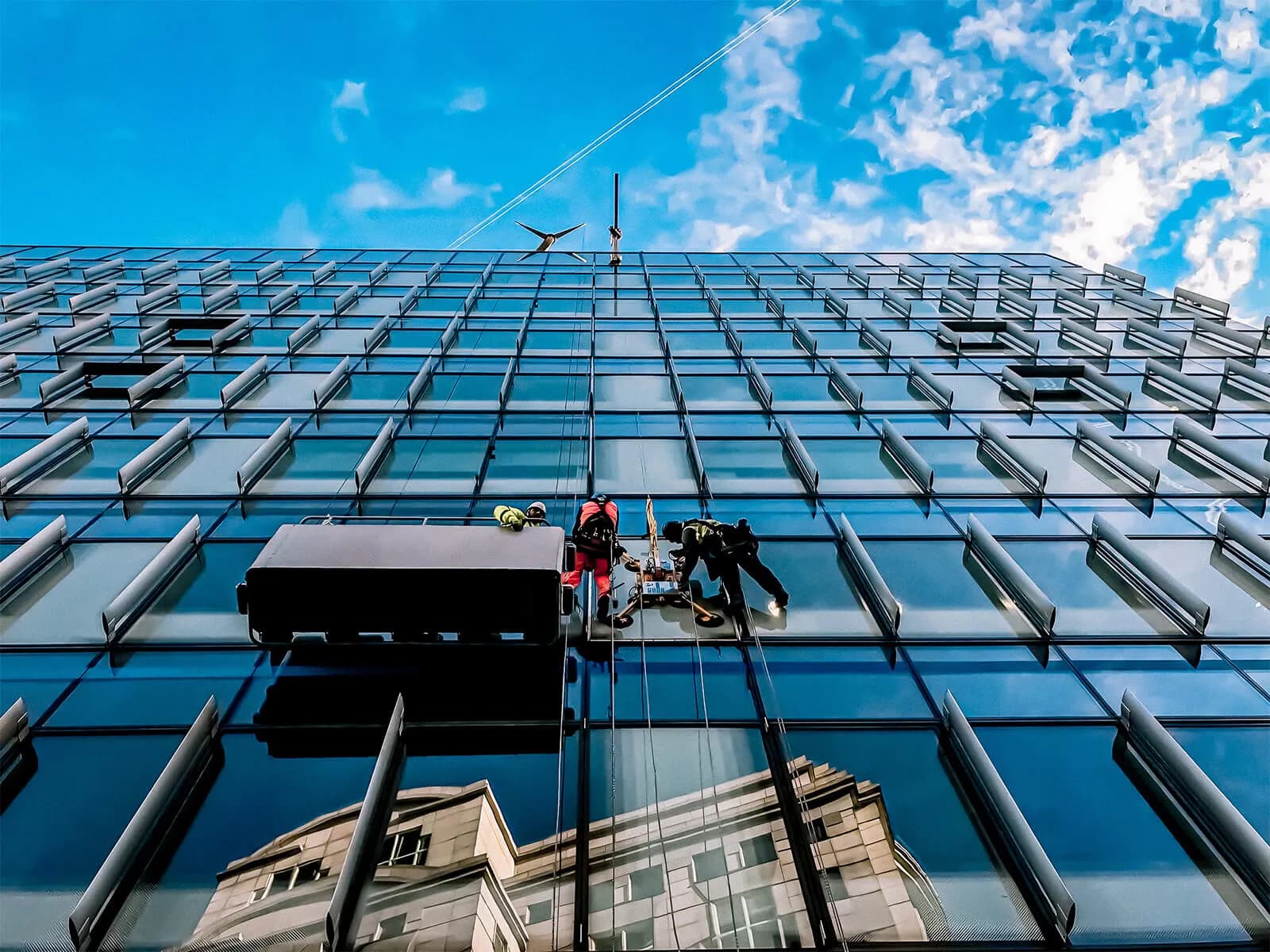
High-Level Glass Replacement Singapore: Rope Access, Gondola & Crane Methods
High-Level Glass Replacement in Singapore: Access Methods Explained
Replacing a glass panel on the ground floor is a straightforward job. Replacing the same panel on the twentieth floor of a Singapore high-rise is an entirely different undertaking — one that requires certified personnel, engineered access methods, detailed risk assessments and, often, approval from multiple parties.
This guide explains how high-level glass work is actually carried out, what each access method involves, and what drives the cost.
Why High-Level Glass Work Is Different
- Work at height risk — falls remain one of the leading causes of workplace fatalities in Singapore.
- Glass weight — a 12 mm panel measuring 2.5 m x 1.5 m weighs around 110 kg. Large facade panels can exceed 300 kg.
- Wind loading — at height, wind can make panel control extremely difficult and dangerous.
- Falling object risk — the area below must be protected at all times.
- Access complexity — not every building has a gondola, and not every facade can be reached by crane.
- Approvals — permits, method statements and building management coordination are mandatory.
Access Methods Compared
1. Rope Access (IRATA)
Technicians descend or ascend on ropes anchored to the building structure, working directly on the facade.
- Setup time: Fast — often under an hour
- Panel size: Small to medium (typically up to ~80 kg for manual handling)
- Best for: Isolated panels, awkward locations, buildings without gondola access
- Cost: $$ – $$$
- Certification: IRATA Level 1–3 or equivalent
2. Gondola (Suspended Working Platform)
A suspended platform lowered from a roof-mounted davit system. Common on Singapore high-rises.
- Setup time: Medium — requires rigging and testing
- Panel size: Medium to large
- Best for: Continuous vertical runs, repeated panel replacement
- Cost: $$$ – $$$$
- Requirements: Building must have gondola systems and approved rigging points
3. Scaffolding
A temporary structure providing full access to the facade.
- Setup time: Slow — days to weeks
- Panel size: Any size, plus a working platform for equipment
- Best for: Large-scale facade works, multiple panels, extended projects
- Cost: $$$$ (but efficient per panel on large jobs)
- Requirements: Permit for scaffold erection, ground space, hoarding
4. Scissor Lift / Boom Lift
Mobile elevating work platforms, usually for indoor or mid-height work.
- Setup time: Fast
- Panel size: Medium
- Best for: Atriums, indoor high walls, low-rise exteriors
- Cost: $$
- Requirements: Suitable floor loading and clear access route
5. Crane-Assisted Installation
A mobile crane lifts oversized or heavy glass panels into position.
- Setup time: Medium — requires lifting plan and exclusion zone
- Panel size: Very large / very heavy (300 kg+)
- Best for: Feature facades, oversized panels, structural glazing
- Cost: $$$$ – $$$$$
- Requirements: Lifting plan, certified riggers, traffic management, permits
6. Spider-Man / Building Maintenance Unit (BMU)
Alternative rope-based or mechanical access for particularly difficult facade geometries.
| Method | Setup Time | Max Panel Weight | Cost | Best For |
|---|---|---|---|---|
| Rope Access | Fast | ~80 kg | $$–$$$ | Isolated panels |
| Gondola | Medium | ~200 kg | $$$–$$$$ | Vertical runs |
| Scaffolding | Slow | Unlimited | $$$$ | Large projects |
| Scissor / Boom Lift | Fast | ~150 kg | $$ | Indoor & low-rise |
| Crane | Medium | 500 kg+ | $$$$–$$$$$ | Oversized panels |
Safety and Regulatory Requirements in Singapore
High-level work in Singapore is governed by the Workplace Safety and Health Act and its subsidiary regulations. Key requirements:
- Risk assessment — a documented RA must be prepared and communicated to all workers.
- Method statement — describes the sequence of work, access method, equipment and emergency procedures.
- Work at height certification — all personnel must be trained and certified.
- IRATA certification — for rope access technicians and supervisors.
- Permit to work — issued by the building or principal contractor before work begins.
- Fall protection — harnesses, anchor points, lifelines and, where required, safety nets.
- Exclusion zone — the area below must be barricaded and monitored.
- Tool tethering — all tools secured against dropping.
- Rescue plan — a written plan for recovering a suspended worker.
- Insurance — public liability and workman's compensation coverage.
The most common cause of high-level glass incidents is not equipment failure — it is inadequate planning. A thorough method statement prevents more accidents than any piece of hardware.
Step-by-Step: A Typical High-Level Panel Replacement
- Initial survey — assess the panel size, weight, position, surrounding structure and access options.
- Method selection — choose rope access, gondola, crane or scaffold based on weight, location and budget.
- Risk assessment and method statement — documented and approved.
- Permits and approvals — building management, landlord, and where relevant, authorities.
- Site preparation — establish exclusion zone, protect finished surfaces, brief all crew.
- Access setup — rig ropes, test gondola, or mobilise crane.
- Glass fabrication and delivery — cut, tempered and delivered to site on schedule.
- Removal of damaged panel — controlled extraction with edge protection.
- Installation of new panel — positioned with suction lifters or lifting frame, then set on blocks.
- Sealing — structural silicone or gaskets applied to specification.
- Clean-up and demobilisation — remove access equipment, clean glass and clear the site.
- Handover — inspection, documentation and warranty.
What Drives the Cost
| Factor | Impact |
|---|---|
| Height | Higher floors need more rope, longer crane reach or taller scaffolding |
| Panel size and weight | Heavier panels require mechanical lifting, not manual handling |
| Access method | Scaffolding and cranes cost far more than rope access |
| Glass specification | Laminated, Low-E and oversized glass cost more |
| Building approvals | Mall and CBD buildings have stricter requirements |
| Urgency | Emergency call-outs and night work carry premiums |
| Duration | Multi-day access setups cost more in equipment rental |
Indicative Costs in Singapore
| Item | Estimated Cost (SGD) |
|---|---|
| Rope access mobilisation (per day) | $600 – $1,500 |
| Gondola mobilisation (per day) | $1,200 – $3,000 |
| Scaffolding (per sqm of facade) | $25 – $60 |
| Scissor / boom lift (per day) | $250 – $700 |
| Crane hire (per day, incl. riggers) | $1,800 – $5,000 |
| High-level glass panel replacement (per panel) | $1,200 – $6,000+ |
| Facade inspection (rope access) | $500 – $2,000 |
For a single panel on a mid-floor facade, total cost typically ranges from $1,500 to $4,000. For oversized panels requiring a crane and full traffic management, costs can exceed $10,000.
Common Challenges on Singapore Buildings
- No gondola davits — many older buildings were not designed for suspended access.
- Adjacent structures — neighbouring buildings can obstruct crane or scaffold placement.
- Ground-level constraints — busy roads, pedestrian walkways and MRT entrances restrict setup.
- Landscaped podiums — cannot support heavy equipment or scaffold legs.
- Curtain wall systems — panels may be structurally glazed and difficult to extract individually.
- Occupied buildings — work must not disrupt residents or tenants.
- Weather — sudden thunderstorms require rapid suspension of work.
Choosing a High-Level Glass Contractor
| Check | Why |
|---|---|
| BCA CR06 / CR01 certification | Confirms registration for structural and general glass works |
| IRATA certification | Rope access competence for technicians and supervisors |
| Work at height certification | Mandatory for all personnel |
| Public liability insurance | Covers damage or injury to third parties |
| Method statement and RA | Demonstrates planning, not improvisation |
| Equipment condition | Ropes, harnesses and lifters must be inspected and certified |
| References for similar buildings | Proven experience on high-rise facades |
Frequently Asked Questions
Can any glass contractor do high-level work?
No. High-level facade work requires specific certifications (IRATA for rope access, work at height training for all personnel), insurance, equipment and documented planning.
How long does a high-level glass replacement take?
A single panel via rope access can often be completed in one day. Gondola or scaffold works may take several days including setup. Crane works are usually completed in a single day but require significant preparation.
Is rope access safe?
Yes, when performed by IRATA-certified technicians with proper anchors, equipment inspection and a rescue plan. It is a widely used and well-regulated method worldwide.
Do I need to inform my neighbours?
Usually yes. Crane lifts, scaffolding and exclusion zones affect common areas and adjacent units. Building management should coordinate notification.
What happens if the weather turns bad?
Work stops. High-level glass work is suspended during strong wind, lightning or heavy rain — safety takes priority over schedule.
Can you board up a broken high-level panel temporarily?
Yes. Emergency boarding and temporary weatherproofing is a standard first response while replacement glass is fabricated.
High-Level Glass Works by RH Glass Solution
RH Glass Solution Pte Ltd carries out high-level glass replacement and installation across Singapore using certified rope access crews, gondola systems, scaffolding, lifts and crane-assisted methods. We are BCA-certified (CR06/CR01) and fully insured.
- Phone / WhatsApp: +65 8616 1337
- Email: rhglasssolution@gmail.com
- Website: www.rhglasssolution.sg
- Address: 3013 Bedok Industrial Park E, #03-2092
- Hours: 24 hours, 7 days