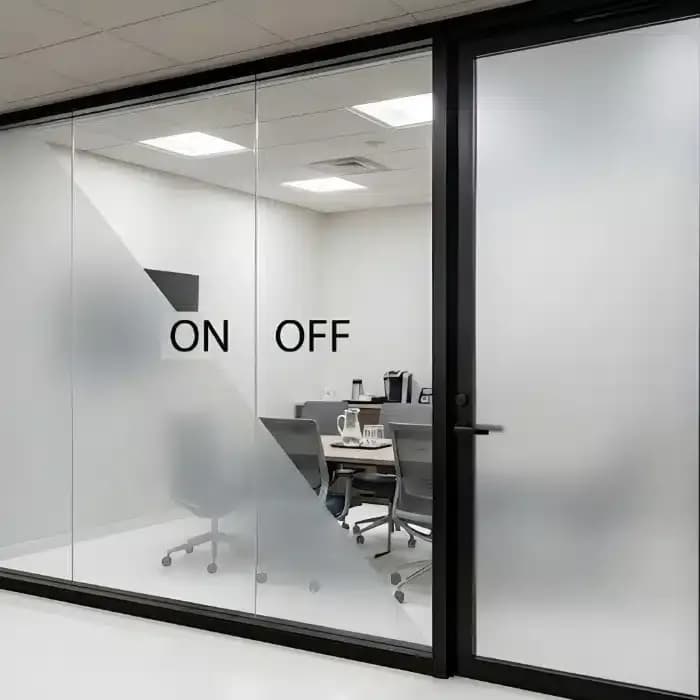
Smart Switchable Glass Singapore: PDLC Privacy Glass Explained
Smart Switchable Glass in Singapore: Everything You Need to Know
Imagine a glass wall that is completely transparent during a client presentation, then turns instantly opaque when a confidential discussion begins — with no blinds, no curtains and no dust. That is smart switchable glass, and it is rapidly becoming standard in Singapore's premium offices, clinics, hotels and luxury residences.
This guide explains how the technology works, where it performs well, what it costs and what to watch out for.
What Is Smart Switchable Glass?
Smart switchable glass — also called PDLC glass (Polymer Dispersed Liquid Crystal), privacy glass, or electronic glass — is laminated glass containing a thin film of liquid crystals. When no voltage is applied, the crystals scatter light randomly and the glass appears frosted. Apply a low AC voltage and the crystals align, making the glass transparent.
How PDLC Works
- A PDLC film is sandwiched between two layers of glass with PVB interlayers.
- In its natural (power-off) state, liquid crystal droplets are randomly oriented. Light scatters in all directions, producing a milky white appearance.
- When a low AC voltage (typically 60–110V) is applied, the crystals align along the electric field.
- Light passes straight through and the glass becomes clear.
- Remove the power and the glass returns to frosted within milliseconds.
PDLC glass is not the same as electrochromic glass. Electrochromic glass changes tint (darkens) and is used for solar control. PDLC changes between clear and frosted and is used for privacy. They solve different problems.
Key Technical Specifications
| Parameter | Typical Value |
|---|---|
| Power-off state | Frosted / opaque (privacy mode) |
| Power-on state | Clear / transparent |
| Switching time | 10–100 milliseconds |
| Light transmission (clear) | 75–82% |
| Light transmission (frosted) | 50–60% haze |
| Operating voltage | 60–110V AC |
| Power consumption | 3–7 W per sqm |
| UV blocking | >98% |
| Sound insulation | Approximately Rw 32–36 (laminated build-up) |
| Service life | 10+ years typical |
Types of Switchable Glass
Self-Adhesive PDLC Film
A retrofit film applied to existing glass. Cheaper but less durable — the film edge is visible and can peel in humid environments.
Laminated PDLC Glass
The PDLC film is permanently laminated between glass panes. Durable, clean-edged and the standard for new installations. Recommended for all professional applications.
Double Glazed Switchable Units
PDLC laminated glass combined into a DGU with an air gap. Adds thermal and acoustic performance on top of privacy control.
Where Switchable Glass Makes Sense
Corporate Meeting Rooms
The classic application. Glass walls keep the office open and bright, while a switch delivers instant privacy when needed.
Medical and Dental Clinics
Consultation and treatment rooms benefit from non-porous, easy-to-disinfect surfaces and on-demand privacy without blinds that collect dust and bacteria.
Executive Offices
Directors' offices that need to feel open but require privacy for calls and discussions.
Banks and Financial Services
Client meeting rooms where confidentiality is essential and visual transparency builds trust.
Hotels and Hospitality
Bathroom and bedroom dividers in premium suites — a high-impact guest feature.
Luxury Residences
Master bathroom dividers, home offices and feature walls in condominiums and landed homes.
Retail and Showrooms
Windows that turn opaque for after-hours security while remaining clear for daytime display.
Switchable Glass Cost in Singapore
| Application | Specification | Estimated Cost (SGD) |
|---|---|---|
| Self-adhesive film (retrofit) | Per sqm | $350 – $550 |
| Laminated PDLC glass | 5+5 mm, per sqm | $650 – $1,000 |
| Laminated PDLC glass | 6+6 mm, per sqm | $750 – $1,200 |
| Double glazed PDLC unit | 5+12+5 mm, per sqm | $1,000 – $1,600 |
| Transformer | Per unit | $150 – $400 |
| Switch / remote control | Per point | $80 – $250 |
| Smart app / BMS integration | Per system | $600 – $2,500 |
A typical 12 sqm meeting room partition with laminated PDLC glass, transformer and switch typically costs between $9,000 and $16,000 installed.
Wiring and Control
PDLC glass requires a hidden electrical connection, which must be planned at design stage.
- Transformer — steps down mains power to the required AC voltage. Usually concealed in a ceiling void or service cupboard.
- Wiring — low-voltage cables are run within the frame, floor channel or ceiling. For frameless installations, wiring is typically routed at the top or bottom edge.
- Control options — wall switch, remote control, smartphone app, timers, occupancy sensors and full BMS integration.
- Zoning — multiple panels can be grouped so different areas switch independently.
Always decide on wiring routes before the partition frame is installed. Retrofitting wiring into a finished frameless partition usually means removing glass.
Advantages of Switchable Glass
- Instant privacy — no waiting for blinds to close.
- No dust or allergens — nothing to clean except the glass itself.
- Hygienic — ideal for clinical environments.
- Design continuity — the glass wall stays visually consistent.
- Space efficiency — no space needed for blind pockets.
- Energy savings — blocks a significant amount of solar heat.
- Security — windows can turn opaque at night.
- Wow factor — a genuine differentiator for premium spaces.
Limitations to Understand
- Not fully opaque from very close range — at certain angles and distances, silhouettes may be visible in frosted mode. It provides visual privacy, not absolute concealment.
- Requires power — privacy mode is the default (power-off), which is a safety advantage, but you must plan for electrical supply.
- Acoustic performance is limited — laminated PDLC gives roughly Rw 32–36. For higher acoustic requirements, a separate acoustic system is needed.
- Cannot be cut after lamination — all sizes must be finalised before manufacture.
- Higher cost — roughly 3–5 times a standard laminated glass partition.
Care and Maintenance
- Clean with a soft cloth and mild non-ammonia cleaner.
- Never use abrasive pads or solvents.
- Do not allow water to pool on exposed edges.
- Check the transformer location is ventilated.
- Exercise the switch periodically to keep the crystals responsive.
- Report flickering or slow switching early — it usually indicates a transformer issue.
Frequently Asked Questions
Is switchable glass frosted or clear when the power is off?
Frosted. Power-off is the privacy state. This is a deliberate safety design so a power failure never leaves a space unexpectedly transparent.
How long does PDLC glass last?
Typically 10+ years. The film degrades slowly with UV exposure, which is why laminated construction is preferred over surface-applied film.
Can I retrofit switchable film to my existing glass?
Yes, self-adhesive PDLC film can be applied to existing glass, though laminated PDLC glass offers better durability and appearance for new installations.
Does switchable glass reduce noise?
Moderately — around Rw 32–36 depending on build-up. It is not a substitute for a dedicated acoustic partition.
Can it be controlled by phone?
Yes. App control, voice assistant integration and BMS connectivity are all available.
Is it suitable for bathrooms?
Yes, provided the edges are properly sealed and the transformer is located in a dry area.
Upgrade to Smart Glass
RH Glass Solution Pte Ltd supplies, installs and maintains PDLC switchable glass in Singapore, including all wiring, transformers and control systems. We are BCA-certified (CR06/CR01).
- Phone / WhatsApp: +65 8616 1337
- Email: rhglasssolution@gmail.com
- Website: www.rhglasssolution.sg
- Hours: 24 hours, 7 days